Nineteen Semitones and a Prayer: Ear Training Lessons From the National Anthem
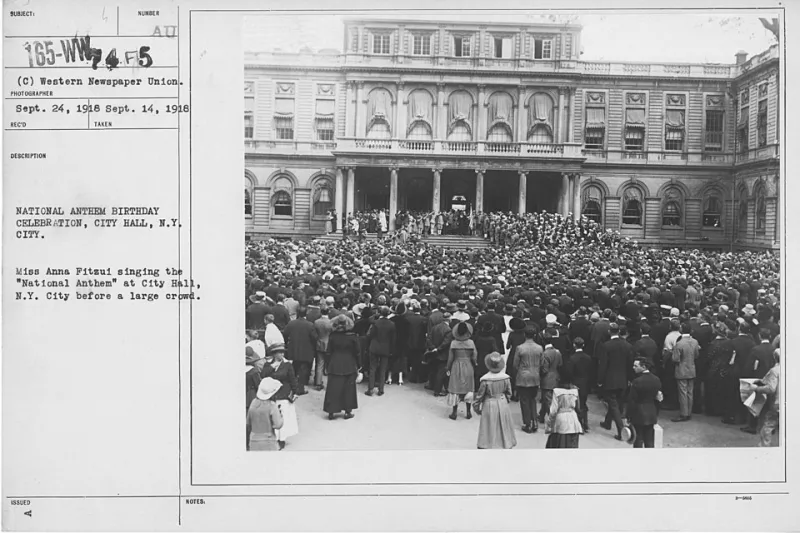
Photo: Unknown authorUnknown author or not provided, Public domain, via Wikimedia Commons
Every year, somewhere in a stadium in this country, a brave volunteer steps to a microphone, takes a breath, and starts a song that is roughly an octave and a half wide. Some of them land it. Many do not. The rest of us watch from the stands and quietly think: I could never.
Here's the thing, though. You don't have to sing it. You can study it. "The Star-Spangled Banner" is a free, pre-loaded ear-training obstacle course that most Americans already know by heart, which makes it weirdly perfect for training intervals, contour, and scale-degree awareness — no vocal cords required, no sheet music required, no courage required.
A tune that was never built for a ballpark
Francis Scott Key wrote the words in 1814 during the bombardment of Fort McHenry. The melody came from somewhere else entirely — a British social club song called "To Anacreon in Heaven," written for a room of amateur singers with, presumably, more rehearsal time than a seventh-inning stretch allows.
It became the official national anthem in 1931. Since then it has been a beloved, mangled, endlessly re-arranged piece of American public life. That's part of why it's useful: there is no single definitive version. Every arrangement makes slightly different choices, so your ear has to do the work rather than memorizing a fixed set of keys.
Why it trips people up
The short answer is range. The tune spans about nineteen semitones between its lowest note and its highest, which is a full octave plus a good stretch of a fifth. Most popular songs live comfortably inside an octave. This one asks for a home run swing.
The long answer is that the hard part isn't one note — it's where the hard notes sit. The big payoff arrives late in each verse, after you've already spent your air on the climb. Singers who start too high (which is most of us, nerves being what they are) run out of ceiling exactly when the song needs the most room.
Reading the course map
You can treat the melody as five stations, and each one trains a different listening skill. The exact pitches depend on the arrangement, so do the honest thing and pull up any recording — the shape will be the same.
Station 1: the opening pickup. The song does not start on the note people expect. The little pickup syllables sit noticeably below the first strong syllable, which then leaps upward. That leap is the first gasp in the anthem. Listen for how far up it goes — a fourth is a good bet in most lead sheets, but check it yourself. That's the assignment.
Station 2: the long stepwise climb. "By the dawn's early light" is mostly motion in small steps — a ladder rather than a jump. Stepwise motion is the easiest thing for a beginner ear to track, which makes it the friendliest stretch of the song.
Station 3: the repeated notes. Mid-verse phrases hover and repeat a pitch before moving again, which is why they feel like a held breath. Repeated notes are sneaky: they're easy to sing and hard to hear as a shape, because nothing seems to be happening.
Station 4: the high payoff. The famous top note arrives on the word "free" — and often again on "brave" at the close. Scale-wise, it's the note that sits at the very top of the tune's usable range, usually a strong scale degree that sounds like a flash of sunlight rather than a step in a ladder.
Station 5: the walk home. After the peak, the melody descends and settles. That descent is your reward for paying attention: it lands on home, and home is easy to feel even if you can't name it.
Four ear workouts, zero singing talent
Find your do first. Play a sustained tonic drone on any instrument or free app, hum it, and just sit in it for thirty seconds. Then sing the anthem's opening pickup against that drone. This single habit — anchor first, sing second — fixes about half of the anthem's reputation.
Hum the skeleton, skip the words. Strip the melody down to three or four notes: the pickup, the top of the climb, the high peak, and the final landing. Sing only those, on "doo." Now you're hearing the architecture instead of fighting the lyrics.
Call and response. Have a friend play or hum two seconds of the tune; sing it back. Small chunks only. Two seconds of melody is plenty — the anthem punishes people who try to swallow it whole.
Transpose it down and mean it. Nobody said the key on the radio is the key for your apartment. Move the whole thing down a third or a fourth, sing it there, and notice how much easier the intervals become to hear when your throat isn't complaining. The skills transfer even when the pitch doesn't.
The unpopular opinion
Here it is: this is not a vocal technique problem for most of us. It's an interval-recognition problem wearing a stadium poncho.
The anthem is hard because it contains a wide leap, a long stepwise climb, repeated notes, a high-register payoff, and a descent that has to land cleanly — all in the space of a minute. That is, almost exactly, a beginner ear-training curriculum. We just happen to have attached a national ritual to it and then convinced ourselves we aren't allowed to practice it.
So the next time a singer takes that breath at the fifty-yard line and the crowd winces preemptively, listen differently. Count the stations. Find the leap. Feel for the peak. You'll hear a song you've heard a thousand times, and this time you'll hear how it's built.